Thursday, July 18, 2013
What are the uses of alloys and how do their properties change?
Alloys are metals made by combining two or more metallic elements. Some of their uses include transportation, construction, ductility, aircraft turbine engines, and high corrosion resistance. Their properties change in ways such as a hardness of their steel forms, and the iron depends on the amount of the carbon added. Also, the change in iron depends on the processing it underwent.

2SDS 7-13 p.204
7. An alloy is a solid combination of atoms of two or more metals. Alloys also include some well-defined compounds.
8. Two alloys I use regularly are steel and 14-carat gold.
9. Carbon (C) is a component of both steel, and stainless steel.
10. Chromium-platinum alloy:
Formula: Cr3Pt
Use: basis of some commercial razor blade edges.
Physical property: very hard
8. Two alloys I use regularly are steel and 14-carat gold.
9. Carbon (C) is a component of both steel, and stainless steel.
10. Chromium-platinum alloy:
Formula: Cr3Pt
Use: basis of some commercial razor blade edges.
Physical property: very hard
11. Elements that behave as semiconductors are located on the break between metals and nonmetals--metalloids.
12. Three elements commonly used for doping semiconductors include phosphorus (P), arsenic (Ar), and aluminum (Al).
13. The primary use of the products of semiconductor technology is the allowance for computers to process digital information.
Wednesday, July 17, 2013

2SDS #1-6 p.204
1. Allotropes are forms of an element in the same state.
2. Oxygen and silicon also form allotropes.
3. a. A diamond is the hardest substance known, is is not electrically conductive, and it has an extremely high melting point. It is also rare, making it is very expensive. Coal is very combustible and cheap. Pencil lead, made of graphite, is a useful lubricant, a conductor of electricity, extremely soft, and very common and cheap.
b. Their properties are different because although they are made of the same element, they are allotropes of carbon, and therefore, have very different atomic arrangements. c. The rigid, three dimensional structure of carbon atoms in diamonds indicates its high melting point, hardness, and rareness that accounts for its high cost. The atomic makeup of graphite and coal indicate their much more common, more reactive, and softer properties, and therefore, their cheaper prices.
4. Engineered materials are materials developed by scientists and engineers to enhance natural materials through manufacturing methods that carefully control the microstructure of the materials. On the other hand, the makeup of natural materials, however, is uncontrolled and untouched.
5. Ceramics are durable and have high melting points and strength at high temperatures. However, ceramics are also brittle and when rapidly exposed to high and low temperatures, will crack or break.
6. Plastics can be customized to be either soft or hard. For example, polyethylene can be tailored to display soft properties, such as a squeeze bottle for water, or tailored to be hard and brittle, like glass. Plastic can also be made into optical fibers, which replace copper wires and provide noise free communication systems with high capacities.
2. Oxygen and silicon also form allotropes.
3. a. A diamond is the hardest substance known, is is not electrically conductive, and it has an extremely high melting point. It is also rare, making it is very expensive. Coal is very combustible and cheap. Pencil lead, made of graphite, is a useful lubricant, a conductor of electricity, extremely soft, and very common and cheap.
b. Their properties are different because although they are made of the same element, they are allotropes of carbon, and therefore, have very different atomic arrangements. c. The rigid, three dimensional structure of carbon atoms in diamonds indicates its high melting point, hardness, and rareness that accounts for its high cost. The atomic makeup of graphite and coal indicate their much more common, more reactive, and softer properties, and therefore, their cheaper prices.
4. Engineered materials are materials developed by scientists and engineers to enhance natural materials through manufacturing methods that carefully control the microstructure of the materials. On the other hand, the makeup of natural materials, however, is uncontrolled and untouched.
5. Ceramics are durable and have high melting points and strength at high temperatures. However, ceramics are also brittle and when rapidly exposed to high and low temperatures, will crack or break.
6. Plastics can be customized to be either soft or hard. For example, polyethylene can be tailored to display soft properties, such as a squeeze bottle for water, or tailored to be hard and brittle, like glass. Plastic can also be made into optical fibers, which replace copper wires and provide noise free communication systems with high capacities.
Tuesday, July 16, 2013
2SCS: p.181 #13-21
13. a. 6 moles NH3 are needed to react with 9 mol PbO.
b. 5 moles N2 are produced by the reaction of 10 mol NH3.
c. 5 moles Pb are produced from 5 mol PbO.
c. 28 g N2 can be produced from 34.0 g NH2.
d. 415 g PbO, which fully reacts, will produce 415 g Pb.
216+32=248. 216g/248g x 100%=
87% silver by mass
b.
molar masses: Al, 54g; O, 48g
54+48=102. 54g/102g x 100%=
53% aluminum by mass
c.
molar masses: Ca, 40g; C, 12g; O, 48g
40+12+48=100. 40g/100g x 100%=
40% calcium by mass
207+32+64=303. 207g/303g x 100%=
68% lead by mass
b.
5g/50g x 100%=
10% PbSO4 in the ore sample. c.
68 x .10=
6.8% Pb in the total ore sample. d.

b. 5 moles N2 are produced by the reaction of 10 mol NH3.
c. 5 moles Pb are produced from 5 mol PbO.
14. a. 1 mol N2 can be produced from 34.0 g NH3.
b. 621 g Pb can be produced from the complete reaction of 3.0 mol PbO.c. 28 g N2 can be produced from 34.0 g NH2.
d. 415 g PbO, which fully reacts, will produce 415 g Pb.
15. Due to the percent of the oxygen atoms being 67%, since oxygen's molar mass is 32 and carbon's molar mass is 12 in this molecule, the percent oxygen by mass 32g/44g x 100%, or 73%.
16. a.
molar masses: Ag, 216g; S, 32g216+32=248. 216g/248g x 100%=
87% silver by mass
b.
molar masses: Al, 54g; O, 48g
54+48=102. 54g/102g x 100%=
53% aluminum by mass
c.
molar masses: Ca, 40g; C, 12g; O, 48g
40+12+48=100. 40g/100g x 100%=
40% calcium by mass
17. a.
molar masses: Pb, 207g; S, 32g; O, 64g207+32+64=303. 207g/303g x 100%=
68% lead by mass
b.
5g/50g x 100%=
10% PbSO4 in the ore sample. c.
68 x .10=
6.8% Pb in the total ore sample. d.

18. a. Reusing is when you use the same product more than 1 time for the same thing, but recycling means the product is used again but for another reason or purpose.
b. Reusing- Clothes and Containers
Recycling- Old computer parts and Composed piles
19. a. Solar energy, biomass, wood, and natural gas
b. Coal, fossil fuels, food oil/petroleum, and gas
20. a. Reusing
b. Recycling
c. Recycling
21. A light bulb can only be recycled but a newspaper could be reused and recycled for different things.
Monday, July 15, 2013
2SCS p.180 #1-12
1. The law of conservation of matter states that matter is neither created nor destroyed.
2. A scientific law summarizes what has been learned by careful observation of nature.
3. These expressions are misleading because as the law of conservation of matter states, matter is neither created nor destroyed. They just change.
4. a. Not balanced.
Reactant: Sn-1, H-1, F-1 Product: Sn-1, H-2, F-2 b. Not balanced. Reactant: Si-1, O-2, C-1 Product: Si-1, O-1, C-2 c. Balanced Reactant: Al-1, O-3, H-6, Cl-3 Product: Al-1, O-3, H-6, Cl-3
5. a. The coefficient for hydrogen gas: 3. b. The coefficient for NH3 gas: 2. c. The coefficient for nitrogen gas: 1.
6. a. 1, 3, 1, 3

b. 2, 3, 3, 2

c. 4, 2, 3

7. a. 1 Ca3(PO4)2 + 3 H2SO4 --> 2 H3PO4 + 3 CaSO4 b. 2 C8H18 + 25 O2 --> 16 CO2 + 18 H2O
8. a. Yes, the atoms are conserved. Reactant: Na-2, S-1, O-4, K-2, Cl-1 Product: Na-2, S-1, O-4, K-2, Cl-1 b. No, the student did not create a properly balanced chemical equation. This is because the subscripts are suppose to stay the same, and the coefficients are suppose to alter to balance the equation. c. 1 Na2SO4 + 2 KCl --> 2 NaCl + 1 K2SO4
9. It would take 400,000 seconds to spend one mole of dollars if I could spend a billion dollars per second.
10. a. oxygen gas (O2): 32g b. ozone (O3): 48g c. limestone (CaCO3): 100g d. a typical antacid Mg(OH)2: 58g e. aspirin (C9H8O4): 180g
11. They can both correctly represent 1.00 mol of a substance because atomic mass equals atomic weight; the weight always stays the same.
12. a. 1 atom in 39.1g potassium b. .5 atoms in 19.55g potassium c. .1 atoms in 3.91g potassium d. .03 atoms in 1.0g potassium
2. A scientific law summarizes what has been learned by careful observation of nature.
3. These expressions are misleading because as the law of conservation of matter states, matter is neither created nor destroyed. They just change.
4. a. Not balanced.
Reactant: Sn-1, H-1, F-1 Product: Sn-1, H-2, F-2 b. Not balanced. Reactant: Si-1, O-2, C-1 Product: Si-1, O-1, C-2 c. Balanced Reactant: Al-1, O-3, H-6, Cl-3 Product: Al-1, O-3, H-6, Cl-3
5. a. The coefficient for hydrogen gas: 3. b. The coefficient for NH3 gas: 2. c. The coefficient for nitrogen gas: 1.
6. a. 1, 3, 1, 3

b. 2, 3, 3, 2

c. 4, 2, 3

7. a. 1 Ca3(PO4)2 + 3 H2SO4 --> 2 H3PO4 + 3 CaSO4 b. 2 C8H18 + 25 O2 --> 16 CO2 + 18 H2O
8. a. Yes, the atoms are conserved. Reactant: Na-2, S-1, O-4, K-2, Cl-1 Product: Na-2, S-1, O-4, K-2, Cl-1 b. No, the student did not create a properly balanced chemical equation. This is because the subscripts are suppose to stay the same, and the coefficients are suppose to alter to balance the equation. c. 1 Na2SO4 + 2 KCl --> 2 NaCl + 1 K2SO4
9. It would take 400,000 seconds to spend one mole of dollars if I could spend a billion dollars per second.
10. a. oxygen gas (O2): 32g b. ozone (O3): 48g c. limestone (CaCO3): 100g d. a typical antacid Mg(OH)2: 58g e. aspirin (C9H8O4): 180g
11. They can both correctly represent 1.00 mol of a substance because atomic mass equals atomic weight; the weight always stays the same.
12. a. 1 atom in 39.1g potassium b. .5 atoms in 19.55g potassium c. .1 atoms in 3.91g potassium d. .03 atoms in 1.0g potassium
Metal Report
Metal Report
Lithium
It's no myth, just call us lith.
Nicolette, Nina, and Makena
7.15.13

The production of lithium is a vital factor in the study of the metal. Lithium is found in the crystallized salt, and in the brine that underlies the crust. The recovery of lithium form hard rock metals through an open pit or underground hard rock mines using conventional mining techniques. The ore is then processed and concentrated using several methods before direct use or further processing into lithium compounds.
Some current uses for lithium include the following: mental illnesses, including bipolar disorder, depression, and schizophrenia; for eating disorders, including anorexia and bulimia; and for blood disorders, including anemia and low white-cell count (neutropenia). Although lithium is still used in bipolar disorder medications, it is less common nowadays.
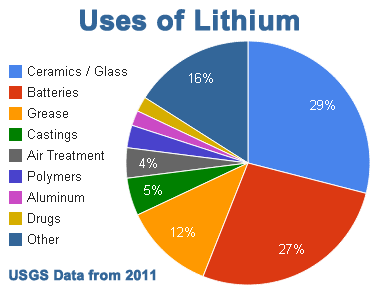
Lithium is also used for headache, alcoholism, epilepsy, diabetes, liver disease,kidney disorders, arthritis, a skin condition called seborrhea, and overactive thyroid. Also, lithium is used in heat transfer applications and it is used as an alloying agent in synthesizing organic compounds.
Other uses include treatment of asthma, Huntington’s disease, Graves' disease,herpes simplex, a movement disorder called tardive dyskinesia, Tourette’s syndrome, cyclical vomiting, Meniere's disease, a tingling or “crawling” sensation in the skin (paresthesias), and aggressive behavior in people with attention deficit-hyperactivity disorder (ADHD).
Lithium is also used in batteries; however, due to its high cost, scientists are trying to replace this lithium ion battery into zinc air batteries which are less costly, more energy dense, and safer. Valporic acid mimics lithium, and is another alternative for treated bipolar disease.
Exactly how lithium works is unknown, but what we know is that it helps mental disorders by increasing the activity of chemical messengers in the brain.
Properties of
Lithium
|
Malleability and ductility: high
Electrical conductivity: high
Thermal conductivity: high
Chemical reactivity: high
Resistance to corrosion: low
Useful alloys formed: high
Color and luster: grey and metallic
|
Chemical Properties
of Lithium
|
Atomic number: 3
Atomic mass: 6.941
Density: 0.53 g.cm
Melting point: 180.5 °C
Boiling point: 1,342 °C
Isotopes: 2
Discovered by: Johann Arfvedson
|
There is a 92.5% natural abundance of lithium. Lithium is the 25th most abundant element on the earth. The uses and demands of lithium are met easily by the production of the metal, and meet the high demand.


Subscribe to:
Posts (Atom)